Why Reconstitution Matters
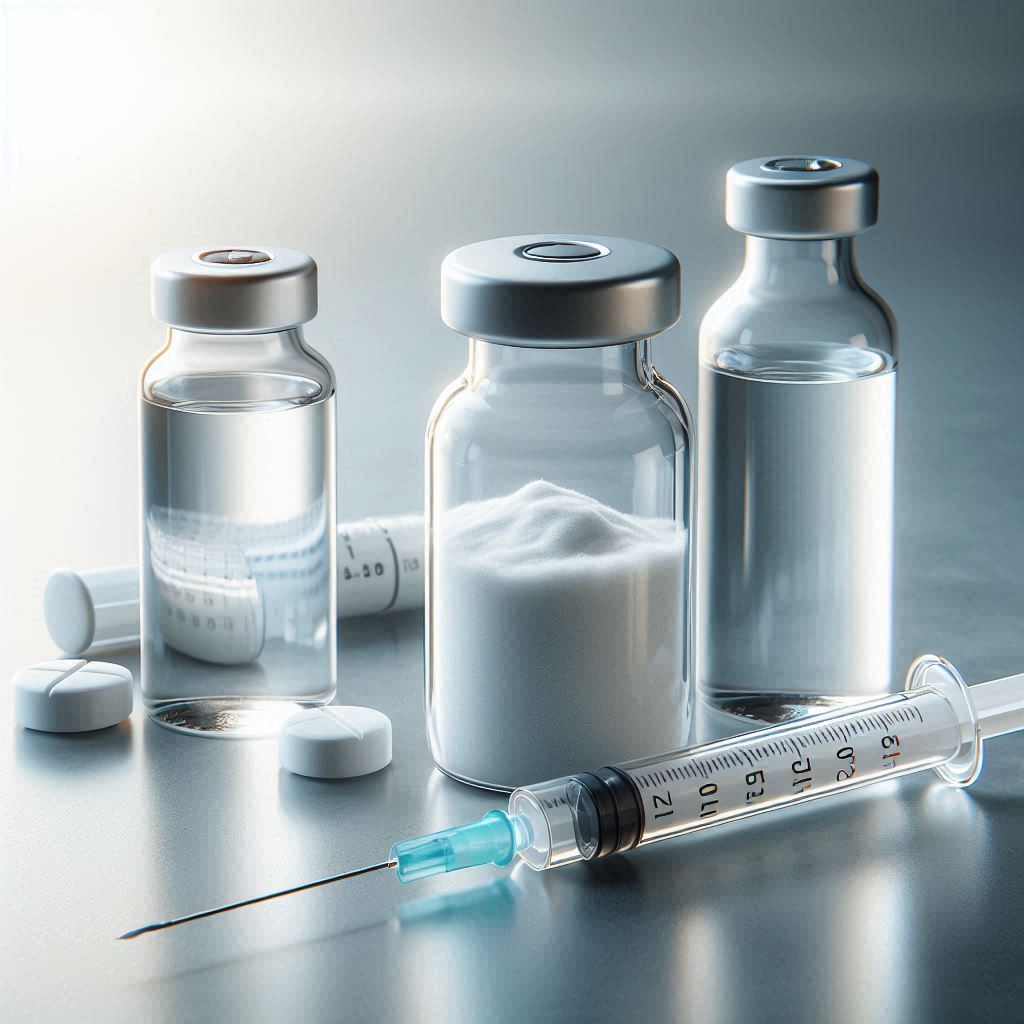
Peptides ship lyophilized (freeze-dried) for stability. They are a powder in a vial. Laboratory handling literature describes adding bacteriostatic water to return that powder to solution before any work is done with it.
The failure modes documented at this stage:
- Denaturation of the peptide chain
- A solution far more or far less concentrated than the record says
- Microbial contamination of a multi-use vial
- Benzyl alcohol concentration high enough to sting
Done carefully, the result is a stable solution whose concentration is actually known.
What the Literature Lists as Materials
Core materials
-
Bacteriostatic water (BAC water)
- NOT sterile water (no preservative)
- NOT saline (denatures some peptides)
- Contains 0.9% benzyl alcohol as preservative
- Supports multi-use over 28 days
-
Syringes
- Transfer: 1-3mL syringe for moving BAC water
- Measurement: insulin-graduated syringes (29-31 gauge, 1/2" needles)
- Needles are single-use in every published protocol
-
Alcohol swabs
- For the vial septa
- For surface prep
-
The peptide vial
- The label states the mass in the vial
- Common masses: 2mg, 5mg, 10mg
Also commonly listed
- Sharps container for needle disposal
- A clean, uncluttered bench
- A calculator (or the one linked below)
The Reconstitution Sequence
Stage 1: workspace
Published protocols specify a clean flat surface, good lighting, materials laid out in advance, and thoroughly washed hands.
Stage 2: temperature equilibration
Vials are taken out of refrigeration and left 15-20 minutes. Cold powder meeting warmer water is described as thermal shock to the compound.
Stage 3: septum cleaning
Both septa, peptide vial and BAC water vial, are wiped with an alcohol swab and left 10 seconds to dry.
Stage 4: drawing the bacteriostatic water
Working out the volume:
This is the step that confuses most people. The arithmetic is simple:
| Peptide Amount | BAC Water | Result per 0.1mL (10 units) |
|---|---|---|
| 5mg | 1mL | 500mcg per 0.1mL |
| 5mg | 2mL | 250mcg per 0.1mL |
| 10mg | 1mL | 1000mcg per 0.1mL |
| 10mg | 2mL | 500mcg per 0.1mL |
The formula:
mcg per 0.1mL = (peptide mg × 1000) ÷ (mL of water × 10)
Worked example: 5mg BPC-157 + 2mL BAC water
- 5 × 1000 = 5000mcg in the vial
- 5000 ÷ 20 = 250mcg per 0.1mL
The calculated volume of BAC water is drawn into the transfer syringe.
Stage 5: introducing the water (the step that ruins vials)
The single most consequential step in the sequence. Published protocols describe it as:
- The needle passes through the rubber septum
- The stream is aimed at the vial wall, never at the powder
- The plunger moves slowly
- Water runs down the side of the glass
- Nothing is squirted directly onto the cake
The reason: direct hydraulic impact denatures protein structure. Gentle introduction preserves the chain.
Stage 6: dissolution
- Vigorous shaking is universally warned against
- Gentle swirling where needed
- Dissolution typically completes in 1-3 minutes
- A finished solution is completely clear
- Cloudiness or visible particulate signals a problem
Stage 7: storage
- Refrigerated immediately (2-8°C / 36-46°F)
- Protected from light
- 28-day working window with bacteriostatic water
- Freezing a reconstituted vial is warned against everywhere
The Six Documented Failure Modes
1. Water fired straight onto the powder
The most common reported error. It can denature the peptide on contact. The stream belongs on the vial wall.
2. Sterile water substituted for BAC water
Sterile water carries no preservative. Once the septum is broken:
- The vial has no multi-use window
- Contamination risk climbs sharply
3. Shaking the vial
Vigorous agitation aerates the solution and can shear peptide structures. Swirling does not.
4. Arithmetic errors
A misplaced decimal is a 10x error in concentration. Every published protocol says the math gets checked twice.
5. Storage lapses
Reconstituted peptide held at room temperature degrades fast. Refrigeration is not optional in the literature.
6. Reused needles
Each septum penetration uses a fresh needle in published practice. Reuse dulls the tip and raises contamination risk.
Reading Concentration Off a Graduated Syringe
What the graduations mean
Insulin-graduated syringes are marked in "units" (IU), which are volume marks, not mass:
- 100-unit syringe = 1mL total volume
- 50-unit syringe = 0.5mL total volume
- 10 units = 0.1mL
Concentration reference
A 5mg vial brought up in 2mL of BAC water works out to:
| Mass in solution | Volume | Graduation |
|---|---|---|
| 100mcg | 0.04mL | 4 units |
| 250mcg | 0.1mL | 10 units |
| 500mcg | 0.2mL | 20 units |
| 750mcg | 0.3mL | 30 units |
A 10mg vial in the same 2mL:
| Mass in solution | Volume | Graduation |
|---|---|---|
| 250mcg | 0.05mL | 5 units |
| 500mcg | 0.1mL | 10 units |
| 1000mcg | 0.2mL | 20 units |
| 1500mcg | 0.3mL | 30 units |
The general formula
Graduation = (mass in mcg × total mL water × 100) ÷ (peptide mg × 1000)
Skip the arithmetic → our free Reconstitution Calculator resolves concentration instantly.
What Published Handling Guidance Covers Beyond the Vial
Preparation literature stops at the solution. Beyond that point, published handling guidance in the clinical record describes site cleaning with alcohol, allowing the alcohol to dry before contact, slow and steady delivery, light pressure afterwards, and rotation between sites across a series. Angles, depths and tissue selection are clinical decisions that sit with a qualified prescriber, not with a preparation guide, and peptibase does not publish them.
Troubleshooting the Solution
It will not dissolve
- Reported dissolution can take up to 5 minutes
- Very gentle swirling only
- Undissolved chunks past 10 minutes suggest a damaged vial
- Check the date on the label
It came out cloudy
- Can indicate contamination or denaturation
- Persistent cloudiness is treated as a failed vial
- Transient cloudiness during dissolution is normal
The numbers do not reconcile
- Re-read the mass on the label (5mg? 10mg?)
- Re-check the water volume
- Use a calculator rather than estimating
Reported stinging
The three explanations in the literature: delivery too fast, placement too shallow, or sensitivity to benzyl alcohol, which is rare. Alcohol that has not fully dried is the other common cause.
Preparation Checklist
Before reconstitution:
- Vial at room temperature
- Bacteriostatic water on the bench
- Fresh syringes and needles
- Alcohol swabs
- Arithmetic checked
During reconstitution:
- Both septa cleaned
- Water introduced SLOWLY down the vial wall
- Not shaken
- Fully dissolved
- Solution clear
After reconstitution:
- Refrigerated immediately
- Labelled with the date
- Concentration recorded
- 28-day window tracked
Resolve the Concentration Math
Decimal errors are the expensive kind. Our free Reconstitution Calculator does the arithmetic:
- Enter the mass in the vial (mg)
- Enter the water volume (mL)
- Get the exact graduation for any mass in solution
→ Open Reconstitution Calculator
Educational content about laboratory preparation of research compounds. Research use only. Not for human or veterinary use. Nothing here is medical advice or a protocol to follow.
Researching peptides? Track your protocols free.
Pro members save 10% on every shop order, all year, with no cap.
Topics covered:
Enjoyed this article?
Get an email when we publish a new guide, when something sold out is back, or when a price drops.